Poverty of Lázaro and those around him
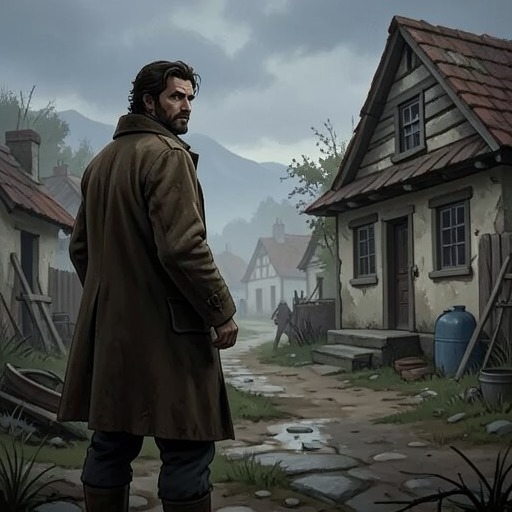
Lazarillo de TormesThe poverty of Lázaro and those around him governs the movement of the story from one household and master to another. It is measured in bread withheld, scraps shared, unpaid rent, and the small earnings that can be kept after a day’s work. Hunger does more than expose vulnerability: it trains Lázaro to improvise, alters his loyalties, and gradually shifts him from dependent child to worker with savings of his own.
Household Poverty and Unequal Provision
Lázaro begins in a household without secure protection or income. His father, Tomé González, works at a mill beside the Tormes, where Lázaro is born; when Lázaro is eight, Tomé is prosecuted for taking grain from the sacks brought to the mill. He later joins an expedition against the Moors as a muleteer and dies alongside his lord. His widowed mother, Antona Pérez, moves to the city, rents a small house, cooks for students, and washes clothes for stable boys. Her work makes the household’s survival dependent on precarious service rather than property or steady provision.
That household improves when Zaide begins visiting and brings bread, pieces of meat, and firewood. The food changes Lázaro’s first fear of his dark-skinned stepfather into attachment: he recognizes the practical relief his presence gives the family. But this support comes from theft. Zaide takes barley, bran, firewood, grooming tools, aprons, horse blankets and trappings, and eventually horseshoes, using the stolen goods to help Antona raise her younger child. When the theft is discovered, Zaide is whipped and grease is poured on his wounds; Antona is also punished and forbidden to enter the commander’s house or receive Zaide. The episode shows a household’s dependence on informal resources, and how quickly that precarious arrangement can be broken by the authorities.
Hunger as a Daily Economy
Under the blind man, Lázaro’s poverty takes the form of calculated deprivation. Although his master earns and possesses much, he gives the boy less than half of what he needs. Lázaro says that without his own cunning and tricks he would have died of hunger repeatedly. His master keeps bread and other food in a cloth bundle secured by an iron ring and padlock. Lázaro unpicks and resews a seam to steal pieces of bread, bacon, and sausage after the bundle has been locked. The theft is not an escape from poverty but an improvised response to a ration too small to sustain him.
The priest at Maqueda makes scarcity still more explicit. He keeps onions locked in an attic room and grants Lázaro one every four days, carefully monitoring the key and the boy’s portion. The priest spends five blancas a day on meat for himself at lunch and supper, shares the broth, but gives Lázaro only a little bread—less than half of what he needs. On Saturdays he buys a sheep’s head for three maravedís, eats its eyes, brains, and meat around the jaws, and leaves the boy the picked bones. The disparity is not simply between a full and empty larder: the priest can afford food but controls its distribution so tightly that Lázaro remains hungry beside him.
This deprivation makes hunger a practical teacher. When the priest seals the old chest against rats, Lázaro finds no gap through which even a fly could enter. He has already learned to take only a little from the loaves he can reach; later, awake at night and listening to the priest’s rough snoring, he uses a knife as a drill to make a hole in the chest where its rotten wood is weakest. He takes bread already cut and returns quietly to his pallet. The account presents ingenuity as a response to bodily need: Lázaro’s planning, timing, and choice of tools are shaped by the repeated problem of staying alive.
The Squire’s Hunger and the Cost of Honour
With the poor squire, deprivation changes its visible form. The new master’s house has decent rooms and a small patio, but its entrance is so dark and gloomy that it frightens visitors. Lázaro follows the squire there after a morning spent in church, expecting that the delay means food is being prepared. Instead, the hour advances toward two without any sign of a meal. The squire’s dignified entrance and carefully arranged cloak offer no evidence of a meal waiting inside; appearances and provisions have come apart.
The squire sends Lázaro to fetch water and asks him to guard the house, while he goes out with the bearing of a gentleman of rank. Lázaro reflects that his master has gone a day without eating except for a piece of bread the boy carried in his chest, and that he has no towel with which to dry himself. For eight or ten days, the squire continues to go out with a lifted nose and stately step while Lázaro begs alms for him. Lázaro discovers an empty, limp velvet purse and understands that the man has no money to give. Unlike the blind man and the priest, who had money yet starved him, the squire is poor and cannot provide. Lázaro therefore pities him rather than hating him, sometimes bringing food home at the cost of leaving himself barely fed.
That sympathy does not make the household secure. After a poor grain harvest, the city orders foreign beggars to leave and threatens those who remain with whipping. Four days after the public proclamation, Lázaro sees poor people driven through the Cuatro Calles under the lash and becomes too afraid to beg. Neighbouring women who spin cotton and make caps give him small portions from their own meagre earnings. The squire, meanwhile, goes at least eight days without a bite at home; Lázaro sees him return at noon, thin and gaunt. To preserve his honour, the squire pretends to pick his teeth with a straw, though there is nothing between them, and blames the house’s gloomy, unlucky character for their suffering. Poverty here threatens not only the body but the public performance of status: the squire maintains the gestures of gentility while his servant begs for their food.
When the landlord and the woman who owns the bed arrive to collect rent for two months, the squire promises to change a double coin at the market and asks them to return that evening. He does not come back. The creditors return the next morning, and Lázaro is left with the house key. The master’s departure turns his inability to pay into abandonment of the person who has been supporting him. Poverty binds the two together through Lázaro’s charity, but cannot prevent the squire from escaping the debt by leaving his servant behind.
Work, Savings, and the Measure of Improvement
Lázaro’s circumstances improve when a chaplain at the cathedral hires him to sell water. The chaplain supplies a donkey, four jars, and a whip; Lázaro gives him thirty maravedís each day from his earnings and keeps the remainder, as well as all that he earns on Saturdays. This is a more regular arrangement than begging or stealing, and for the first time the narrative describes his stomach as satisfied. The change is modest but consequential: income can be divided, part returned to the employer and part retained for Lázaro’s use.
After four years of setting his earnings aside, Lázaro can buy second-hand clothes and leave the work. His outfit consists of an old fustian doublet, a worn embroidered shirt with slashed sleeves, a cloak once covered in trimmings, and an old sword, one of Cuéllar’s first. He judges himself dressed as a respectable man and tells the chaplain to take back the donkey because he will no longer continue the trade. His progress is measured not by wealth but by the ability to preserve earnings, dress with dignity, and choose to stop serving in a particular job.
Social and Narrative Significance
The recurring contrast between need and display gives poverty a critical force. The blind man and priest ration food despite having resources; the squire performs gentility despite having none. Lázaro’s own survival depends on recognizing which condition he faces: the first masters provoke theft and resistance, while the squire’s destitution awakens pity and leads the boy to support him. The narrative thus makes food and money evidence of relationships, not incidental background details.
The account of hunger also shapes the story’s episodic movement. Each change of master brings a different arrangement of food, work, shelter, and power, and each arrangement tests the skills Lázaro has acquired. At the priest’s chest, need sharpens his ingenuity; beside the squire, it redirects him toward begging for another person; in the water-selling job, it gives way to saving. Poverty remains material throughout these changes, even when it is also bound up with honour, religious authority, or social standing.
The introductory discussion places this social satire within a work whose authorship remains unknown. Proposed authors include Juan de Ortega, Diego Hurtado de Mendoza, the Valdés brothers, and other writers, but no attribution is supported by conclusive proof. The discussion suggests cultivated Castilian humanism, and possibly the milieu of converts after the 1492 expulsion decree, as possible contexts, pointing to the classical learning of the prologue and the book’s fierce anticlericalism. Those possibilities remain conjectural; the poverty represented in the narrative is more firmly grounded in its repeated, concrete accounting of food withheld, labour performed, debts unpaid, and small savings patiently accumulated.